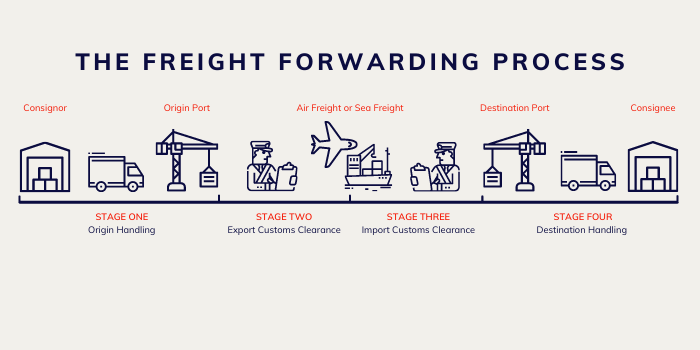
Ask ten exporters what a freight forwarder does and you will get ten answers. The honest one is this: a forwarder is the party that keeps a shipment moving when nobody else is looking at it. Between the day your cargo leaves the factory and the day it clears at the far end, it changes hands a dozen times — trucker, warehouse, terminal, carrier, customs, agent, trucker again. Every one of those handovers is a place where a shipment can quietly stop. The forwarder’s job is to make sure it doesn’t.
That is the work Flash Logistics does for importers and exporters in Pakistan, by sea and by air.
What “global coverage” actually means
No forwarder owns the ships or the aircraft. Coverage comes from the lines, airlines and destination agents you book through, and from knowing which of them is the right one for a given lane, a given commodity and a given week. A route that was fast and cheap last quarter may be neither today — congestion, blank sailings and surcharges move constantly.
So when we say we can move your cargo to or from the world’s major ports and airports, what we mean is concrete: we book the space, we prepare the paperwork, we watch the shipment, and we tell you when something changes. Karachi is our home port and our main office; we also work from Lahore, Islamabad, Faisalabad and Multan, which is where a good deal of Pakistan’s export cargo is actually made.
Sea freight: LCL and FCL
Sea is the default for anything that isn’t urgent, and the economics are hard to argue with. Two ways to buy it:
FCL (Full Container Load) — you take a whole container. It is the cheaper option per unit once you have the volume to fill one, it moves faster through the terminal, and your cargo is not sharing space with anyone else’s.
LCL (Less than Container Load) — you pay for the space you use, and your cargo is consolidated with other shipments. It is the right call for smaller consignments, for new buyers who are still testing a market, and for anyone who would rather not sit on stock waiting to fill a box.
If you are unsure which one your shipment is, that is a normal question and a short conversation — see Sea Freight.
Air freight: when the clock is the constraint
Air costs more per kilo and always will. It earns its price in a narrow set of cases: a production delay you have to make up, a buyer’s deadline you cannot miss, cargo whose value or shelf life makes weeks at sea the expensive option, and the spare part that is holding up a line somewhere. Used deliberately, on the shipments that need it, it is not extravagance — it is the cheaper of two bad weeks. See Air Freight.
Customs clearance and documentation
Most shipments that go wrong don’t go wrong at sea. They go wrong on paper — a description that doesn’t match the invoice, a certificate that was never requested, an HS code that invites a query. We handle clearance and the export and import documentation that goes with it, on both legs, so that the file is right before it is filed rather than corrected after.
Door delivery inside Pakistan
Clearing the port is not the same as arriving. We arrange inland movement from the terminal to your door — or from your factory to the terminal on the way out — across Karachi, Lahore, Islamabad, Faisalabad and Multan, so the shipment is one job with one point of contact rather than a relay you have to run yourself.
Talk to us about your cargo
Every shipment has its own constraints — a deadline, a budget, a commodity that needs particular handling. Tell us what yours are and we will tell you what the realistic options look like, including when the cheaper one is good enough.